Posts

Showing posts with the label Legal-Economic Nexus

Samuels Legal Economic Nexus part 3

  In part 3 of the legal economic nexus, Samuels gets to the heart of the matter by applying his new approach or thinking about implications.  This is arguably also the trickiest part of the paper for him to navigate.  The section starts with a declaration of the need for “objectivity”.  Of course, there will be many who say this is an impossible standard for humans to achieve as every person brings some set of experiences and bias to how they do the work and even the questions they ask or things are interesting to answer.  Certainly, there are a number of institutional economists who would claim that the subjective-objective dichotomy is a false and impractical one. Leaving those arguments aside for the moment, let's explore what Samuels was trying to do here. His main point is he wants to move beyond the power contestations of lawyers or economists as they try to influence the nexus.  He states that there are those who would pretend to be objective but in...
Milton's World: Corporate Regulators or Government Regulators?

Today I was talking to my landlord about the work of Friedman, Sowell, and John Stossel (all individuals whose work he greatly admires). He was talking about "I, Pencil" (or his notion of it) and the way everyone in the world acting in their own self-interest gets a product (a pencil) from point A to point B, without any deliberate notion of all the potential steps that may occur from the time the wood is harvested until it becomes a pencil.  There is no Prime Directive or government action forcing this collection of interactions. The lumberman sells his timber, the processor makes it into various lengths and intermediate products for their customers, those customers may use each individual product for their own purposes.  One of the buyers is the manufacturer of pencils, and he simple sells them to the highest bidder, and off they go to whoever that may be at the time. His point with this story was that there needn't be any unnecessary "government intervention"...

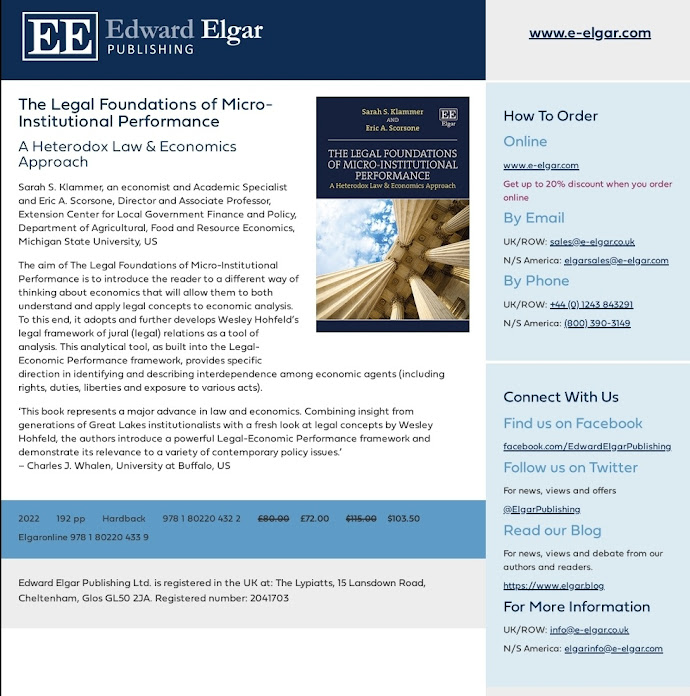
Announcing The Legal Foundations of Micro-Institutional Performance

Image
 Our book is out, and we are more than ready to share it!  After much patience, hard work, and delays on our part (and along the supply chain),  The Legal Foundations of Micro-Institutional Performance: A Heterodox Law & Economics Approach is in print and ready for use in advanced undergraduate law and econ classes, heterodox graduate level classes, and by practitioners conducting impact analysis. I encourage anyone interested to click through the hyperlinked text to view the introduction on Elgar's website-- simply click the cover of the book and the front matter will appear. We anticipate numerous reviews in institutional and law and econ journals in the coming months, and are grateful for any and all feedback directed our way. It's our hope that this framework doesn't stop developing here, but rather continues growing like Al Schmid's Situation-Structure-Performance model upon which the Legal-Economic Performance Framework is loosely based, or the application of ...

Collective Action and a Right to Housing

 Lately, we have been reading John R. Commons' Institutional Economics (Part I).  In it, Commons lays the foundations for a lot of what he sees as the basis of economic transactions, heavily rooted in human psychology, action, and interaction (or, as we like to say-- human interdependence). It is a dense book as explained briefly in Rodrigo's blog contribution last week . One notable component of the Commonsonian approach to economics is the fundamental importance of collective action, or the role collective action plays in shaping the legal rules and informal institutions of the world around us. It's interesting to think about how collective action in relation to housing rights has or may continue to impact existing property law. In Dr. Lisa Alexander's 2015 contribution to the Nebraska Law Review titled, Occupying the Constitutional Right toHousing , she walks through the various Occupy and other housing-strike movements of the recent past, detailing how each is a for...

Thinking About Legal Relations: The Candy Maker/Doctor Example

In working through the idea of human interdependence as the building block for conducting institutional analysis, I frequently return to a couple common examples used in other related literature. I share some of these somewhat-baked thoughts here, as they relate to previous posts about interdependence and using Hohfeld in econ analysis ( here and here ).   One of these is the example of the doctor and the candy maker given by Coase (1960). He described two people operating in offices side-by-side: a doctor, looking for a stable, quiet environment in which to treat patients, and a candy maker, utilizing the space for his or her craft, accompanied by the noisy machinery necessary to do so.  Coase uses the case to demonstrate externalities in his larger discussion of transaction costs, or the cost of any kind of bargaining or solution-finding on the part of the doctor. Many writing about this example have been focused on the external effect of the machines, or the noise cre...

Major Difficulties in Including the Study of Law in Economics

Eric and I recently had the pleasure of chatting with Dr. Pierre Schlag.   Schlag is Distinguished Professor at the University of Colorado and Byron R. White Professor at the Law School.  We had been referencing some of his work on Hohfeldian Legal Analysis for some of our model on legal-institutional interdependence, and he was kind enough to offer to Zoom with us as we worked through our many questions.  We had our conversation about Hohfeld, but Schlag also highlighted one of his past works on the importance of incorporating law into the study of economics.  This 2013 paper, titled " Coase Minus the Coase Theorem-- Some Problems with Chicago Transaction Cost Analysis " is incredibly relevant to all those interested in the intersection of law and economics-- not just those familiar with Coase's larger body of work or those especially familiar with the Coase Theorem.  Schlag provides a comprehensive overview of Coase's broader critique of neoclassical eco...

More on the Importance of Language

Last week, Eric wrote about George Will's thoughts on capitalism and the spontaneous order . I haven't yet read the book,   The Conservative Sensibility (2019) but being from the rural Midwest, I'm pretty familiar  with the conservative heart of his work. Check out Eric's post for a brief  run-down. What's most interesting to me in these kinds of arguments about capitalism and social order is that there are often two distinct kinds of discourse occurring:  we have the defense of some idea or view of how the world ought to be, and we have discussion of how the world currently is, and how we might address issues in it (Will engages in both at times, the former more so in his book, the latter in his columns). What we rarely get in either type of discourse is a clear, detailed definition of the role of government.   There is plenty of opposition to the "centrally planned economy" on the basis of the work of Hayek (the  knowledge problem ) and Ludwig ...

Finding a Better Terminology for Discussing Institutional Structure

A key part of the work Eric Scorsone and I have been doing has centered around this idea of creating a general awareness in students and peers of the institutional, legal underpinnings of economic organization and action.  We borrow heavily from the work done by Al Schmid for the foundation of our institutional thought -- Al was incredibly well read and missed little-- but have noticed a need for more concrete vocabulary and structure for how to teach and talk about institutional structure and changes in it.  Consider this excerpt from Warren Samuels' "Some Fundamentals of the Economic Role of Government"(1989),  "People tend to define socioeconomic reality in terms of legal rights. Government selectively protects, as rights, certain interests and not others-and it is rights that form, structure, and operate through the market and the economy in toto. What people define as reality is thereby formed and reformed. In helping to define and create socioeconomic reali...

Defining Transaction and Transaction Costs

In writing about A. Allan Schmid and his ideas, I've run into a few common themes. One of them is the key idea of human interdependence (as written about in this blog post ), but another is the economists' handling and discussion of transaction costs (also other econ buzz words like free market, externality, etc., but those are topics for other posts). Throughout my reading and writing, I've compiled several notable authors' definitions of transaction costs. A few key differences stand out. The definition, in economics literature, of a transaction is often separate from the definition of transaction cost. This seems important to note, since it is clear to me that economists can mean very different things when they refer to a transaction (not that we always agree on what is considered a cost either). In the 1937 paper, The Nature of the Firm, by Ronald Coase, he does not use the term "transaction cost" but refers to "the cost of using the price mechanism...

Evolution of ILE Ideas: Reviewing some of Schmid's older work

As we continue to learn about the evolution of ILE, a review of some of the older work by Prof. Al Schmid is a helpful guide.  In 1964, Schmid edited and wrote a book called "Agricultural Market Analysis" with his longtime colleague James Shaffer (my IE class was with both of them in 1993 at MSU). Schmid and Sahffer wrote chapter two this text and included some key definitions that are helpful in understanding the evolution of ILE.  these are all quotes from that text: "P osition is the name or social symbol identifying a particular set of role images identifying an individual in relation to the other. Each position carries right and obligations" "I nstitution is defined as an enduring organized set of related positions directing energies of individuals towards a common end". (This is quite different from the definition Al would later use). "Social system is the aggregation of institutions defining the relationships of any group of individu...

Interdependence rethought within ILE

The concept of externality was first introduced to economics, in a formal sense, by Alfred Cecil Pigou in the book "Economics of Welfare" written in 1920 (Medema, 2017).  As Medema points out in his 2017 article, Henry Sidgwick and John Stuart Mill and even Thomas Malthus had identified the idea of externalities earlier but not the word.  From the time of Pigous's 1920 book until about the late 1950's, economists did not really use the idea of externalities.  Medema persuasively argues that it was only used tangentially by economists in developing the new welfare economics, including heavy weights such as all Paul Samuelson, Frank Knight and Abba Lerner. It was mostly used as a potential problem or foil for achieving equilibrium in competitive markets but not an important focus. It was Tibor Scitovistky (1954) who made the first important contribution to the idea that externalities were direct interdependence rather than interdependence due to the existence of mar...

The Power of Michigan Local Health Officials to Combat a Pandemic Disease

This week, given the extreme circumstances surrounding the recent COVID-19 pandemic, we're deviating from our usual ILE content and leaning on the expertise of our in-house law fellow, Samantha Zinnes , to talk about the power local government has in dealing with this type of situation.   The Power of Michigan Local Health Officials to Combat a Pandemic Disease By Samantha Zinnes, Esq. Early last week, Governor Gretchen Whitmer declared a state of emergency as the first confirmed cases of COVID-19, an illness caused by coronavirus, were reported in Michigan. At the same time, the World Health Organization (WHO) officially declared this coronavirus a pandemic. A disease that is a pandemic or epidemic does not necessarily refer to the severity of the actual disease or the complications it causes. Rather, it more has to do with where, when, and how the disease has spread. An epidemic is defined as a clear increase in the normal amount of cases occurring in a commun...