Posts

Showing posts with the label Great Lakes School

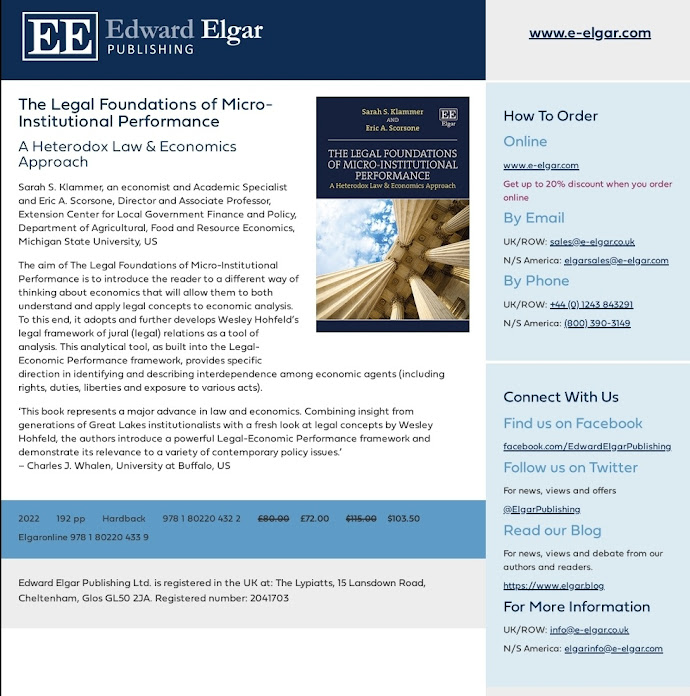
Announcing The Legal Foundations of Micro-Institutional Performance
Image
 Our book is out, and we are more than ready to share it!  After much patience, hard work, and delays on our part (and along the supply chain),  The Legal Foundations of Micro-Institutional Performance: A Heterodox Law & Economics Approach is in print and ready for use in advanced undergraduate law and econ classes, heterodox graduate level classes, and by practitioners conducting impact analysis. I encourage anyone interested to click through the hyperlinked text to view the introduction on Elgar's website-- simply click the cover of the book and the front matter will appear. We anticipate numerous reviews in institutional and law and econ journals in the coming months, and are grateful for any and all feedback directed our way. It's our hope that this framework doesn't stop developing here, but rather continues growing like Al Schmid's Situation-Structure-Performance model upon which the Legal-Economic Performance Framework is loosely based, or the application of ...

From the Archives: John R. Commons Poetry

Image
This week we're in Madison, Wisconsin digging through the John R. Commons Archives. Found this gem along the way, undoubtedly authored by one of JRC's many students. Enjoy! 

Collective Action and a Right to Housing

 Lately, we have been reading John R. Commons' Institutional Economics (Part I).  In it, Commons lays the foundations for a lot of what he sees as the basis of economic transactions, heavily rooted in human psychology, action, and interaction (or, as we like to say-- human interdependence). It is a dense book as explained briefly in Rodrigo's blog contribution last week . One notable component of the Commonsonian approach to economics is the fundamental importance of collective action, or the role collective action plays in shaping the legal rules and informal institutions of the world around us. It's interesting to think about how collective action in relation to housing rights has or may continue to impact existing property law. In Dr. Lisa Alexander's 2015 contribution to the Nebraska Law Review titled, Occupying the Constitutional Right toHousing , she walks through the various Occupy and other housing-strike movements of the recent past, detailing how each is a for...

Commons and Smith on Growing Markets

This guest blog post is posted on behalf of the Center's visiting scholar,  Rodrigo Constantino Jeronimo. Rodrigo is a Ph.D. candidate in Economics at Sao Paulo State University (Unesp/Brazil) and is visiting the Center to work with Eric Scorsone and I on the work of John R. Commons. Commons and Smith on Growing Markets The book “Institutional Economics: its place in political economy” (1934) is one of John R. Commons` densest works in his attempts to provide a clear and organized exposition of the theoretical basis for what he conceived as his institutional economic theory. Undoubtedly, Commons` IE and “The Legal Foundations of Capitalism” (1924) are fundamental references for those aiming at investigating the constitutive elements of a “Commonsian approach” to economics and its phenomena. However, we are talking about a book that had as one of its main objectives reconstructing the history of economic though and placing collective action as the central feature of the economic inv...

Climate Change Adaptation and Whose Interests Count

 The New York Times The Daily podcast for October 11th covered climate change mitigation and adaptation efforts in two North Carolina towns subject to significant flood events over the past several years: Avon and Fair Bluff. It's been 8 year since Hurricane Matthew put the towns under water; 4 since Florence. Both towns are struggling from the realities of the physical collapse caused by flooding and now economic collapse for numerous reasons, notably the loss of residents following each major flood event. In the case of Fair Bluff (pop. 545), they rely on grants and what amounts to many volunteer hours to keep things going and rebuild after every set back. Current economic development goals include rebuilding downtown on higher ground-- but that requires significant funds and a tax base. They discuss federal aid (notably FEMA) who offer to buy out residents in at-risk areas, essentially encouraging residents to leave rather than invest in a rebuild time after time.  This de...

Book Announcement: "Institutional Economics: Perspectives and Methods in Pursuit of a Better World"

This week, we are shamelessly promoting the upcoming Institutional Economics: Perspectives and Methods in Pursuit of a Better World ( Pub: October 28th, 2021).   It is edited by our colleague Charles Whalen, who previously reflected on his career as an institutionalist on this blog here , here , and here . The book covers several major institutionalist perspectives and methods in one place. Other authors include Mary Wrenn, and Bill Waller, who are both interviewed in our Legal-Economic Nexus podcast.  How Charles managed to pull this many-authored volume together throughout a global pandemic (with few setbacks) remains a mystery to me.  Eric and I (with Charles) contributed a chapter in the latter section titled: "Institutional impact analysis: the situation, structure, and performance framework." This chapter covers the evolution of Schmid's model, using old files and drafts we found here at MSU and at the University of Wisconsin to piece together the SSP model. Through...

"The Free Market doesn't exist" and other things I learned in grad school

This coming summer will mark the 4-year anniversary of the passing of Dr. Dave Schweikhardt. Dave was perhaps the most impactful teacher of my graduate career. Over the course of  the past year, notes from his classes (and those taken by others) have moved around my desk numerous times as I hunt for old wisdom or for some great anecdote or quote of his that I want to repurpose for my own curriculum development.  Given the time of year, I wanted to share one of my favorite memories of his Institutional and Behavioral Economics course.  Sometime early in the semester, Dave entered the room one morning and immediately declared, "The free market doesn't exist!" He enjoyed getting right to the point, though it would often take us several minutes to catch up (our course was unfortunately early in the day, addling our response time somewhat). On this day, however, he forced us to formulate some kind of discussion on our own right off the bat. He repeated: "The free market d...

Major Difficulties in Including the Study of Law in Economics

Eric and I recently had the pleasure of chatting with Dr. Pierre Schlag.   Schlag is Distinguished Professor at the University of Colorado and Byron R. White Professor at the Law School.  We had been referencing some of his work on Hohfeldian Legal Analysis for some of our model on legal-institutional interdependence, and he was kind enough to offer to Zoom with us as we worked through our many questions.  We had our conversation about Hohfeld, but Schlag also highlighted one of his past works on the importance of incorporating law into the study of economics.  This 2013 paper, titled " Coase Minus the Coase Theorem-- Some Problems with Chicago Transaction Cost Analysis " is incredibly relevant to all those interested in the intersection of law and economics-- not just those familiar with Coase's larger body of work or those especially familiar with the Coase Theorem.  Schlag provides a comprehensive overview of Coase's broader critique of neoclassical eco...

More on the Importance of Language

Last week, Eric wrote about George Will's thoughts on capitalism and the spontaneous order . I haven't yet read the book,   The Conservative Sensibility (2019) but being from the rural Midwest, I'm pretty familiar  with the conservative heart of his work. Check out Eric's post for a brief  run-down. What's most interesting to me in these kinds of arguments about capitalism and social order is that there are often two distinct kinds of discourse occurring:  we have the defense of some idea or view of how the world ought to be, and we have discussion of how the world currently is, and how we might address issues in it (Will engages in both at times, the former more so in his book, the latter in his columns). What we rarely get in either type of discourse is a clear, detailed definition of the role of government.   There is plenty of opposition to the "centrally planned economy" on the basis of the work of Hayek (the  knowledge problem ) and Ludwig ...

Academic Detective Work #1: Writing About the Origins of a Model

Academic Detective Work: Writing About the Origins of a Model Recently the anniversary of the start of our MSU/Great Lakes Institutional Econ project came and went, with little fanfare other than a brief review of the past year's accomplishments during my annual review. It has always been a little weird to me to see days or months of work summarized in a few bullet points or publications. This got me thinking about all the hours researchers and academics in general can put in to even the most straight-forward seeming pieces. We call it "research", but some of the time our searching takes us well beyond the usual academic channels and requires some TV-montage-worthy sleuthing. In sub-fields like economic history or institutional economics, this is more obvious. In these fields, the ability to do some academic detective work outside of scholarly journals is a large determinant of success in the job. When writing about the origins of a model or of some line of thought, th...

Hospital Bed Capacity, Interdependency and Arguments about Economic Efficiency

Hospital Beds as an Economic Good The building and maintenance of hospital beds is a difficult economic proposition.  Each hospital must decide within the market rules are designed by each state in the United States, how many beds make sense for that facility. Hospital beds are expensive to maintain and represent a high fixed cost.  Much of the costs of a hospital bed must be incurred regardless of actual capacity (Green, 2002) [1] .  An empty bed loses money and is not available to help cover fixed costs. Planet Money Show and Hospital Beds National Public Radio’s (NPR) show “Planet Money” recently had story about the issue of hospital bed economics.   https://www.npr.org/sections/money/ They cite during the show Prof. Zack Cooper from the Yale School of Public Health who talks about the efficiency and inefficiency of hospital beds.  Cooper states in the piece that, “If there are beds, those beds would have gotten used...

Possessive Individualism: A Crisis of Capitalism by Dr. Daniel Bromley (Book Talk)

Image
I wanted to time the posting of this lecture with the release of the book that inspired it. Dr. Daniel Bromley's newest work,  Possessive Individualism: A Crisis of Capitalism, will officially hit shelves this coming Monday, November 11th .  This lecture was advertised through the usual channels in MSU's department of Ag, Food, and Resource Economics and via flyers across campus in the summer of 2019 as part of the Extension Center for Local Government Finance and Policy's first Great Lakes school of Institutional Economics meeting. Also coinciding with that meeting was an interview with Dr. Bromley (available here ). Check out that post for a brief bio. This lecture includes a lengthy reading from Possessive Individualism , as well as spirited discussion between the author and several attendees at the end.  Enjoy! *All participants were aware that they were being filmed and that this would be shared for the benefit and enjoyment of all those that could not or did...

More thinking about Komesar

Upon further reflection of Komesar’s critique of Schmid and others approach to IE and the notion of institutions, here are some further rebuttal remarks.  Schmid perceived that institutions lie within the mind of each individual in a society or group and not simply as a written down dead letter law or rule which appears to be Komeasr’s main point of contention.  John R. Commons wrote of the “institutionalized mind”. I will only focus on the main thinkers in the Great Lakes IE tradition and no others such as North or Williamson. Schmid believed and wrote that institutions are ordered or structured sets of relationships amongst individuals.  Borrowing from John R. Commons and Wesley Hohfeld, an institution told the hodler in their mind of what they can, cannot, must, must not may and may not do.  These “institutions” are carried around in people's minds how they act and react to others around them. The stability of institutions varies and can certainly change ove...

Neil Komesar on Institutional Economics (IE)

Neil Komesar wrote a piece in the book, "Alternative Institutional Structures" that was edited in honor of Al Schmid's retirement entitled "The Essence of Economics".  In that piece, Komesar takes on the approach used by Schmid and north regarding their approach to IE. Komesar believes that Schmid and other economists use the law in a fixed sense as a driver of economic performance.  He does note the difference in performance perspective with Schmid focused on distribution and North, as an example, focused on allocative efficiency.  Komesar believes that this is not a fruitful approach and that law moves around and should be endogenous versus exogenous. The Komesar approach is based on the idea that the number of participants is the driving force in his approach to IE.  A large number of participants increases the transactions and the difficulty of securing cooperative action.  Komesar borrows the two force model from political science to engage in his compa...

A Career In 30 Minutes (Institutional Economics Highlights): Dr. Daniel Bromley

Image
This past May, Dr. Eric Scorsone and I had the opportunity to host meetings with some of those still active and interested in Michigan-Wisconsin Institutional Economics (or the Great Lakes School of Institutional Economics). As part of these meetings, we were able to interview Dr. Daniel Bromley, Emeritus Professor at the University of Wisconsin-Madison in the Department of Agricultural and Applied Economics as part of our oral history project. In a 30-minute interview at the Kellogg Center, Eric (as interviewer) attempted to touch on as many important parts of Bromley's story as possible. The interview starts at the beginning of Bromley's academic career at Utah State in the early 1960's, where he studied Ecology. From there, Bromley talks about his transition into issues of law and institutions, the conception of his earliest works, and ultimately the conception of his latest book, Possessive Individualism: A Crisis of Capitalism (Available October 14th, Oxford P...

Pluralism and ILE's Approach to Economics

A. Allan Schmid was one of the co-founders of Institutional Law and Economics (ILE) from Michigan State University.  He took a balanced and pluralistic view of the value and importance of the various approaches and methodologies.  One of the key questions is the relationship between institutional economics and neoclassical (or so called orthodox) economics.  Schmid, as we will see, took a very balanced and nuanced view of this relationship.  This view helps set the stage for a more general exploration of institutional economics in future blog posts. His writing illustrates his nuanced view of these issues.  Schmid writes that "orthodox economics misses many issues of power" and "neoclassical economics has focused narrowly on that part of psychology that can be captured in the concepts of utility and preferences" (Schmid, pg. 3 and 4).  At the same time, Schmid is complimentary of some of the important advances in neoclassical and welfare economics, he wri...

Some Thoughts from Warren Samuels

Warren Samuels was a co-founder of the Institutional Law and Economics School of Thought from the Economics Department of Michigan State University. Occasionally, we will explore some key quotes or thoughts from Samuels across his long career to see how this school of thought formed and evolved over time. Writing in the Journal of Law and Economics in 1971, Samuels articulated that, "legal impact upon the private economic sphere and the economic use of government have not been the exception; rather then have been the regular and fundamental, perhaps daily pattern.  Both the market mechanism and the legal system, as well as the system of moral rules, are modes of social control and social change." Here we say that the analyst must consider how the two or three spheres of influence, economic, government and moral, are all part of the nature of social control.  Each sphere has its characteristics and ways of working and none of them should be privileged above the other.  T...