Posts

2022 WSSA Association for Institutional Thought Presentation (Denver, CO): The Legal-Economic Performance Framework

Image
 This past March I had the pleasure of presenting a new paper introducing our Legal-Economic Performance Framework to a broad group of Institutionalists at the Western Social Science Association's Annual meeting in Denver, Colorado. This presentation to the Association for Institutional Thought (AFIT) builds off of an example used in a January presentation for the Association for Evolutionary Economics (AFEE) at ASSA. As promised, I've uploaded it here for interested parties.  Thanks to entomologist and travel buddy zmatteen for the video!
Thinking about our new book

  A Hohfeldian jural relations approach forces us to think differently about interdependence than in the standard neoclassical model.  Law is absent for the standard neoclassical model.  Some authors may state that there is an assumption that property rights exist or the rule of law is enforced but it is not explicitly in the model.  Interdependence in the neoclassical model comes from buying or selling power (market power if it exists).  Otherwise, the economics agents are assumed to be autonomous agents whom have a fixed set of preferences and a fixed budget or a fixed cost and production function in the case of a firm.   A Hohfeldian approach forces us to look a the specific, typically legal but could also be related to cultural, rules that exist and create or construct interdependence.  In other words, the legal piece rather than being a background assumption comes to the forefront as a an explicit part of the economic analysis.  This hohfeldi...

Milton's World: Corporate Regulators or Government Regulators?

Today I was talking to my landlord about the work of Friedman, Sowell, and John Stossel (all individuals whose work he greatly admires). He was talking about "I, Pencil" (or his notion of it) and the way everyone in the world acting in their own self-interest gets a product (a pencil) from point A to point B, without any deliberate notion of all the potential steps that may occur from the time the wood is harvested until it becomes a pencil.  There is no Prime Directive or government action forcing this collection of interactions. The lumberman sells his timber, the processor makes it into various lengths and intermediate products for their customers, those customers may use each individual product for their own purposes.  One of the buyers is the manufacturer of pencils, and he simple sells them to the highest bidder, and off they go to whoever that may be at the time. His point with this story was that there needn't be any unnecessary "government intervention"...

Announcing The Legal Foundations of Micro-Institutional Performance

Image
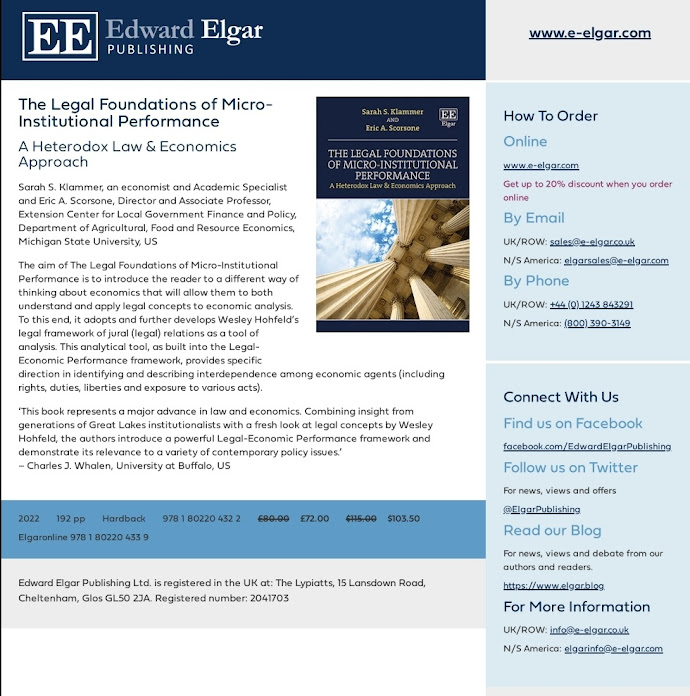
 Our book is out, and we are more than ready to share it!  After much patience, hard work, and delays on our part (and along the supply chain),  The Legal Foundations of Micro-Institutional Performance: A Heterodox Law & Economics Approach is in print and ready for use in advanced undergraduate law and econ classes, heterodox graduate level classes, and by practitioners conducting impact analysis. I encourage anyone interested to click through the hyperlinked text to view the introduction on Elgar's website-- simply click the cover of the book and the front matter will appear. We anticipate numerous reviews in institutional and law and econ journals in the coming months, and are grateful for any and all feedback directed our way. It's our hope that this framework doesn't stop developing here, but rather continues growing like Al Schmid's Situation-Structure-Performance model upon which the Legal-Economic Performance Framework is loosely based, or the application of ...

From the Archives: John R. Commons Poetry

Image
This week we're in Madison, Wisconsin digging through the John R. Commons Archives. Found this gem along the way, undoubtedly authored by one of JRC's many students. Enjoy! 

Collective Action and a Right to Housing

 Lately, we have been reading John R. Commons' Institutional Economics (Part I).  In it, Commons lays the foundations for a lot of what he sees as the basis of economic transactions, heavily rooted in human psychology, action, and interaction (or, as we like to say-- human interdependence). It is a dense book as explained briefly in Rodrigo's blog contribution last week . One notable component of the Commonsonian approach to economics is the fundamental importance of collective action, or the role collective action plays in shaping the legal rules and informal institutions of the world around us. It's interesting to think about how collective action in relation to housing rights has or may continue to impact existing property law. In Dr. Lisa Alexander's 2015 contribution to the Nebraska Law Review titled, Occupying the Constitutional Right toHousing , she walks through the various Occupy and other housing-strike movements of the recent past, detailing how each is a for...

Commons and Smith on Growing Markets

This guest blog post is posted on behalf of the Center's visiting scholar,  Rodrigo Constantino Jeronimo. Rodrigo is a Ph.D. candidate in Economics at Sao Paulo State University (Unesp/Brazil) and is visiting the Center to work with Eric Scorsone and I on the work of John R. Commons. Commons and Smith on Growing Markets The book “Institutional Economics: its place in political economy” (1934) is one of John R. Commons` densest works in his attempts to provide a clear and organized exposition of the theoretical basis for what he conceived as his institutional economic theory. Undoubtedly, Commons` IE and “The Legal Foundations of Capitalism” (1924) are fundamental references for those aiming at investigating the constitutive elements of a “Commonsian approach” to economics and its phenomena. However, we are talking about a book that had as one of its main objectives reconstructing the history of economic though and placing collective action as the central feature of the economic inv...